
| Sample Type | n | Range | Average |
|---|---|---|---|
| Serum | 5 | 88% - 99% | 95% |
| EDTA Plasma | 5 | 87% - 101% | 93% |
| Heparin Plasma | 5 | 89% - 104% | 96% |
| Sample Type | n | 1:2 | 1:4 | 1:8 |
|---|---|---|---|---|
| Serum | 5 | 91-105% | 90-102% | 87-99% |
| EDTA Plasma | 5 | 89-100% | 83-100% | 82-99% |
| Heparin Plasma | 5 | 80-100% | 88-100% | 83-96% |
| Item | Quantity | Storage |
|---|---|---|
| Pre-Coated 96 Well Microplate | 12 x 8 Well Strips | +4°C |
| Lyopholized Standard | 2 Vials | +4°C |
| Sample Dilution Buffer | 20ml | +4°C |
| Biotinylated Detection Antibody | 120µl | +4°C |
| Antibody Dilution Buffer | 10ml | +4°C |
| HRP-Streptavidin Conjugate | 120µl | +4°C |
| SABC Dilution Buffer | 10ml | +4°C |
| TMB Substrate | 10ml | +4°C |
| Stop Solution | 10ml | +4°C |
| Wash Buffer (25X) | 30ml | +4°C |
| Plate Sealers | 5 Adhesive Strips | - |
| Foil Pouch | 1 Zip-Sealed Pouch | - |
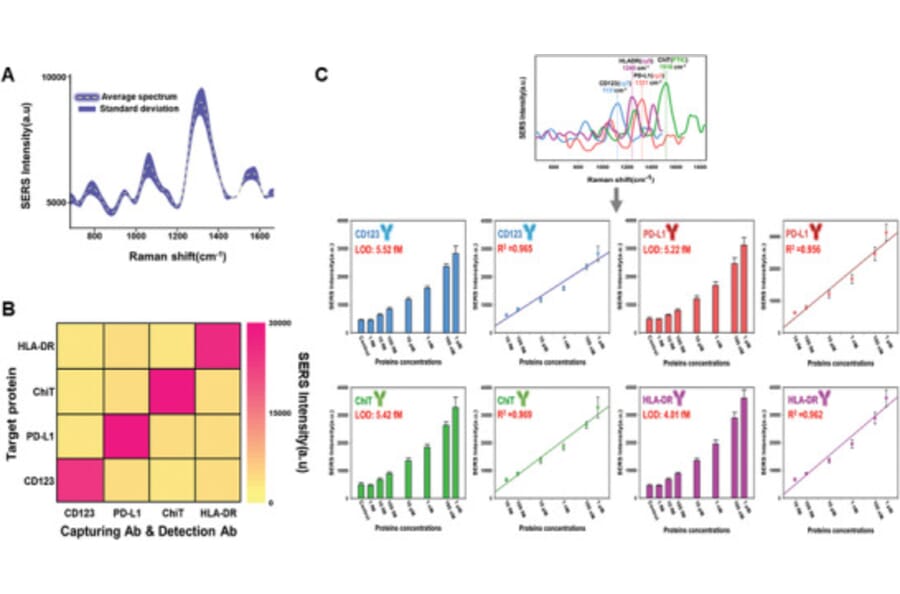
Rapid and accurate differential diagnosis of infections, sepsis, and septic shock is essential for preventing unnecessary antibiotic overuse and improving the chance of patient survival. To address this, a 3D gold nanogranule decorated gold-silver alloy nanopillar (AuNG@Au-AgNP) based surface-enhanced Raman scattering (SERS) biosensor is developed, capable of quantitatively profiling immune-related soluble proteins (interleukin three receptor, alpha chain: CD123, programmed cell death ligand 1: PD-L1, human leukocyte antigen-DR isotype: HLA-DR, and chitotriosidase: ChiT) in serum samples. The 3D bimetallic nanoarchitecture, fabricated using anodized aluminum oxide (AAO), features a uniform structure with densely packed nanogaps on the heads of Au-Ag alloy nanopillars, enabling fast, simple, and replicable production. The proposed biosensor achieves accurate results even with low detection limits (4-6 fM) and high signal consistency (relative standard deviation (RSD) = 1.79%) within a one-step multi-analytes identification chip with a directly loadable chamber. To enhance the diagnostic performance, a support vector machine (SVM) based machine learning algorithm is utilized, achieving 95.0% accuracy and 95.8% precision in classifying healthy controls, infections with and without sepsis, and septic shock. This advanced 3D plasmonic bimetallic alloy nanoarchitecture-based SERS biosensor demonstrates clinical usefulness for sepsis diagnosis and severity assessment, providing timely and personalized treatment.