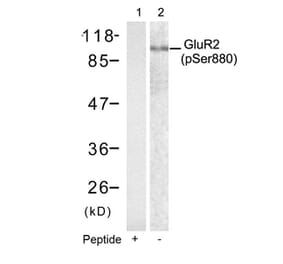
Rabbit polyclonal antibody to Ionotropic Glutamate Receptor 2.
Specificity
This antibody recognises glutamate receptor subunit 2 (GluR2), a component of the AMPA (alpha-amino-3-hydroxy-5-methyl-4-isoxalone propionic acid) group of ionotropic glutamate receptors, which play a key role at excitatory synapses, including synaptic transmission, stabilisation and plasticity.GluR2 is possibly the most important of the AMPA receptor subunits, responsible for AMPA receptor rectifying properties, control of ion flow and in particular the influx of calcium. The majority of GluR2 in the CNS is expressed in the GluR2(R) form, containing a critical arginine residue (as opposed to a glutamine residue) in the Transmembrane region 2 (TM2) domain, thereby rendering native AMPA receptors impermeable to calcium.
Applications
WB
Dilutions
WB: 1:1,000
Reactivity
Rat, Human, Monkey, Mouse, Chicken, Zebrafish
Immunogen
Synthetic peptide corresponding to a region within rat GluR2, conjugated to Keyhole Limpet Haemocyanin.
Host
Rabbit
Clonality
Polyclonal
Isotype
IgG
Conjugate
Unconjugated
Concentration
Lot Specific
Molecular Weight
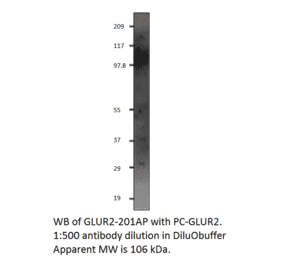
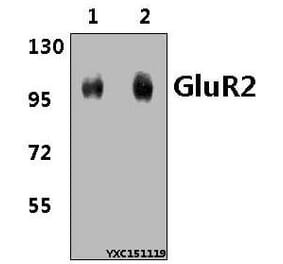
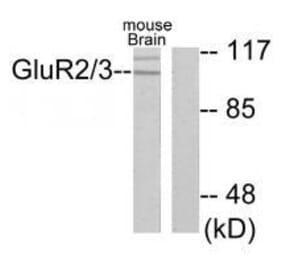
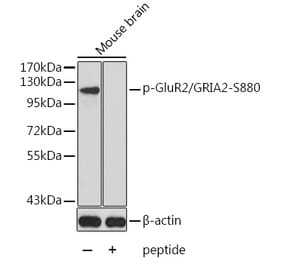
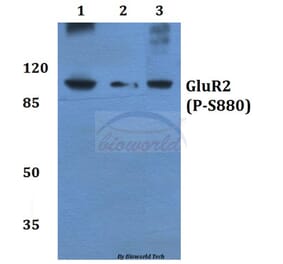
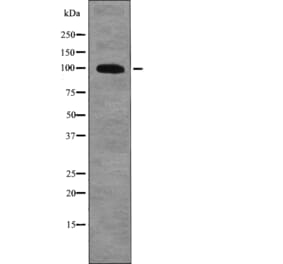
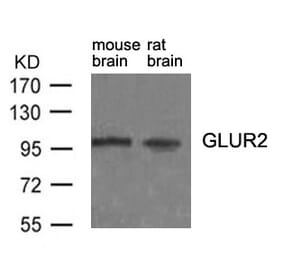
Approximately 100 kDa in rat brain hippocampus cell lysates.
Product Form
Liquid
Formulation
Supplied in 10mM HEPES, pH 7.5, with 0.01% BSA, 50% Glycerol, and 0.09% Sodium Azide.
Storage
Shipped at ambient temperature. Upon delivery aliquot and store at -20°C. When thawed, aliquot the sample as needed. Short term (up to 4 weeks): store at 4°C. Long term: store at -20°C. Avoid freeze / thaw cycles. Storage in frost free freezers is not recommended.
General Notes
Rabbit anti Human GluR2 antibody recognizes glutamate receptor subunit 2 (GluR2), a component of the AMPA (alpha-amino-3-hydroxy-5-methyl-4-isoxalone propionic acid) group of ionotropic glutamate receptors, which play a key role at excitatory synapses, including synaptic transmission, stabilisation and plasticity. GluR2 is possibly the most important of the AMPA receptor subunits, responsible for AMPA receptor rectifying properties, control of ion flow and in particular the influx of calcium. The majority of GluR2 in the CNS is expressed in the GluR2(R) form, containing a critical arginine residue (as opposed to a glutamine residue) in the Transmembrane region 2 (TM2) domain, thereby rendering native AMPA receptors impermeable to calcium.




![Western Blot - Anti-Ionotropic Glutamate receptor 2 Antibody [ARC0572] (A81034) - Antibodies.com](https://cdn.antibodies.com/image/catalog/81/A81034_1.jpg?profile=product_alternative)