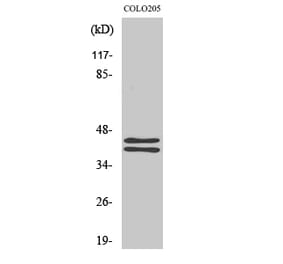
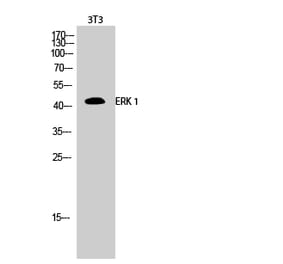
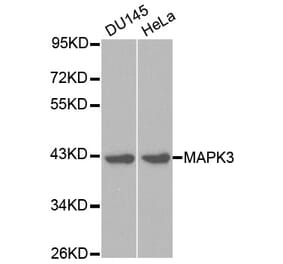
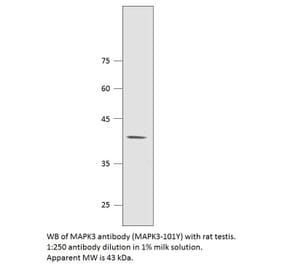
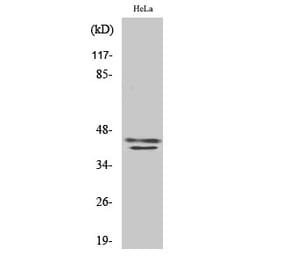
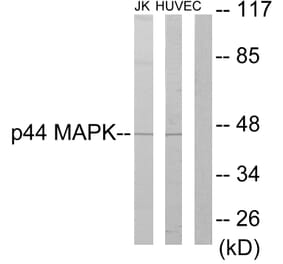
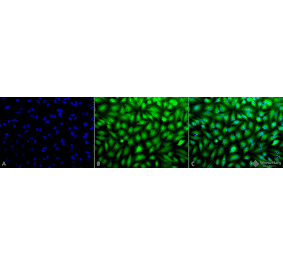
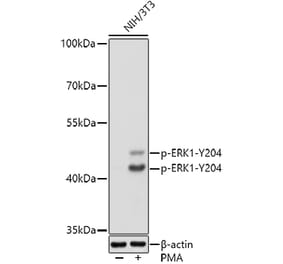
Rabbit polyclonal antibody to ERK1 (phospho Thr202).
Specificity
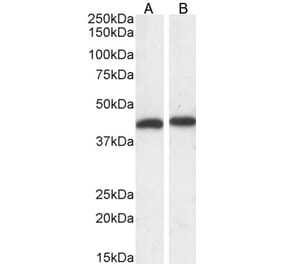
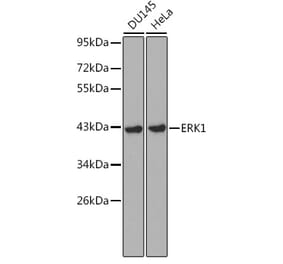
This antibody recognises ERK1, also known as MAPK3, when phosphorylated at threonine 202. ERK1 is a member of the Mitogen Activated Protein Kinase (MAPK) family. MAPKs constitute a diverse set of signaling molecules. In the case of ERK1, a cascade is initiated by binding activation of a membrane bound receptor which causes activation of a small GTPase, RAS, which in turn activates the protein kinase activity of the RAF protein. RAF in turn phosphorylates and activates MEK. MEK induces phosphorylation of ERK1 at residues threonine 202 and tyrosine 204. Phosphorylation of the residues corresponds to activation of ERK1 and mediation of its diverse biological functions including cell growth, differentiation, motility, and adhesion via its effects on transcription, translation, cytoskeletal rearrangement and cross talk with other signaling pathways
Applications
WB, IHC-P
Dilutions
IHC-P: 1:50 - 1:100, WB: 1:500 - 1:2,000
Reactivity
Human, Mouse, Rat
Immunogen
Phospho-specific peptide corresponding to residues surrounding Thr202 of human ERK1.
Host
Rabbit
Clonality
Polyclonal
Isotype
IgG
Conjugate
Unconjugated
Concentration
Lot Specific
Product Form
Liquid
Formulation
Supplied in Phosphate Buffered Saline with 50% Glycerol and 0.02% Sodium Azide.
Storage
Store undiluted at -20°C. Storage in frost free freezers is not recommended. Avoid freeze-thaw cycles. Should this product contain a precipitate we recommend microcentrifugation before use.
General Notes
Rabbit anti ERK1 (pThr202) antibody recognizes ERK1, also known as MAPK3, when phosphorylated at threonine 202. ERK1 is a member of the Mitogen Activated Protein Kinase (MAPK) family. MAPKs constitute a diverse set of signaling molecules. In the case of ERK1, a cascade is initiated by binding activation of a membrane bound receptor which causes activation of a small GTPase, RAS, which in turn activates the protein kinase activity of the RAF protein. RAF in turn phosphorylates and activates MEK. MEK induces phosphorylation of ERK1 at residues threonine 202 and tyrosine 204. Phosphorylation of the residues corresponds to activation of ERK1 and mediation of its diverse biological functions including cell growth, differentiation, motility, and adhesion via its effects on transcription, translation, cytoskeletal rearrangement and cross talk with other signaling pathways




![Western Blot - Anti-ERK1 Antibody [ARC2591] (A306776) - Antibodies.com](https://cdn.antibodies.com/image/catalog/306/A306776_1.jpg?profile=product_alternative)